


Annandale Distillery – 12 Steps Towards Net Zero
 8 mins


1. Maturation of whisky on site (reduction in road miles) – Phase 1 completed, Phase 2 pending
2. Bottling of whisky on site (reduction in road miles) – completed
3. Exergy3 heat storage system using green electricity (fossil fuel reduction) – in progress
4. Photovoltaic electricity production and storage – under active consideration
5. Replacement of process pumps with lower energy equivalents – in progress
6. Recovery of energy from draff, pot ale and spent lees – initial consultation
7. Recovery of additional ‘waste heat’ from distillery production and use of ‘residual heat’ from Exergy3 system, wherever possible – under active consideration
8. Grow barley locally (reduction in road miles) – under active consideration/initial tranche land acquired
9. Malting of barley on site (reduction in road miles) – under active consideration
10. CO2 capture and utilisation – under consideration
11. Source bottles and packaging from Scottish/local suppliers – policy in place
12. Installation of electric vehicle charging points and change over to electric vehicles where possible – policy in place
Maturation of whisky on site:
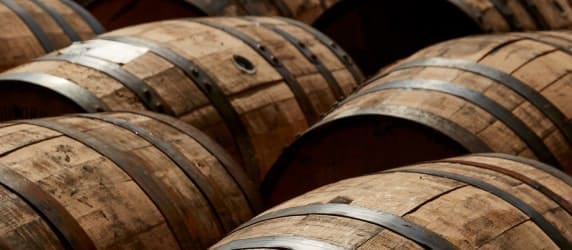
Phase 1 of our new, on-site bonded warehouse was completed during December 2020. All casks were repatriated from a bonded warehouse in Creetown by July 2021 (using transport that would otherwise have been returning from Creetown without a load).
Current levels of production amount to 80 X 200 litre bourbon barrel equivalents/week, over 48 weeks/year, which amounts to 3,840 barrels per year. If a lorry can carry 110 barrels per load, this approximates to 35 return trips, each of 120 miles, which equates to a saving of 4,200 road miles/year.
Construction of a second bonded warehouse (Phase 2) is currently being planned. Together, Phases 1 & 2 should give Annandale Distillery sufficient maturation capacity. Funding is sought for Phase 2.
Bottling of whisky on site:
Our on-site bottling plant was completed in December 2022, since when all our whisky has been bottled on site. As our whisky is still relatively young, we’re currently bottling approximately 500 casks per year. Within the next 5 years, we should be bottling at the same rate that we’re producing, to maintain warehouse stocks at equilibrium. Approximate saving by bottling on site is estimated at 4,200 miles/year.
Additional storage space is required for dry goods (bottles, labels, corks, capsules, and inner and outer packaging). This will be incorporated into Phase 2 of the bonded warehouse.
Exergy3 heat storage system using green electricity:
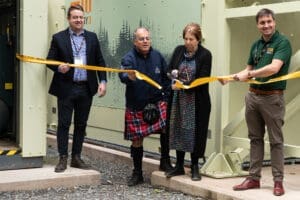
Annandale Distillery is working with Exergy3 Ltd. (a spin off company from Edinburgh University) and Cochran Ltd. (boiler manufacturers, Newbie, Dumfries & Galloway) to install a heat storage system. The storage system will be heated overnight using locally produced green electricity. When steam is required, cold air is blasted through the heat store. The air exits the store and enters the equivalent of the combustion chamber of a boiler at ~600oC, thereafter creating steam in the conventional manner. The efficiency of the system has yet to be determined but it should be sufficient to replace most of our fossil fuel consumption. The Exergy3 heat storage
system is the first of its kind in the World (and consequently, first in the UK, and first in the Scotch Whisky industry), so it’s likely to attract considerable interest, worldwide.
The project is supported by the Department for Business, Energy & Industrial Strategy (now the Department for Energy Security& Net Zero).
Photovoltaic electricity production and storage:
Photovoltaic (PV) panels will be installed on the roof of our existing Bonded Warehouse (Phase 1) and on the roof of Phase 2 when implemented. Electricity will be stored in a bank of batteries. APD Ltd of Newbie, Dumfries & Galloway, has been engaged as consultants. This work will be integrated with the work on the Exergy3 Heat Storage System. PV energy may be used to recharge the storage system as necessary. It may also be used as a source of electricity for the production area, the visitor centre, the distillery offices, and possibly for recharging electric vehicles.
Funds are sought for the feasibility study and for installation of PV panels and transmission lines.
Replacement of process pumps with lower energy equivalents:
A survey was conducted by APD Ltd to measure power usage by the many different pumps used in the production process. Considerable energy savings may be anticipated by switching to more efficient, lower energy pumps. However, as these pumps are very expensive in relation to the energy savings, our policy is to replace the existing pumps with new, lower energy pumps when the existing pumps need to be replaced.
Recovery of energy and various nutrients from draff, pot ale and spent lees:
Currently our draff (spent grains) is taken by the local farmer for cattle feed. Draff is relatively high in cellulose (making it suitable for cattle feed) but also in germ oil and protein (nitrogen). Pot ale, which is the residue left in the wash still after the initial distillation, consists largely of dead yeast cells which are relatively high in nitrogen. This is currently treated as effluent and sprayed on fields as an alternative to other nitrogen fertilisers. Pot ale is also copper-rich (our soil is often copper deficient). Spent lees is relatively high in energy. Our current strategy, which is common across the Scotch Whisky industry, does not make best use of these residual materials. Initial enquiries made to the Scotch Whisky Research Institute suggest that this is relatively low priority (for them).
Annandale Distillery is consulting with Dr Michael Lewis of the University of Reading to find alternative ways of utilising distillery waste. Dr Lewis is an internationally recognised expert in dealing with dairy waste, where there are many parallels with the Scotch Whisky industry.
Funds are sought to conduct an initial review of distillery effluent and current practices for recovering energy and nutrients on a small scale.
Recovery of additional ‘waste heat’ from distillery production and use of ‘residual heat’ from Exergy3 system:
Annandale Distillery recovers a considerable amount of heat by pre-heating various liquids via heat exchangers. Inevitably, this process could be more efficient. We will work with Dr Lewis to review the efficiency of our heat exchangers and otherwise to look for further efficiencies in terms of heat recovery. This would go hand-in-hand with the energy recovery review proposed immediately above.
It is possible that residual heat, recoverable from the Exergy3 Heat Storage System could be used for drying wet barley post-malting. (Most maltsters use electricity and/or fossil fuels to dry the wet barley malt.) This would be integrated with the local maltings proposed below.
Grow barley locally:
Historically, the South of Scotland has not been recognised as a whisky producing area although, as several local distilleries (especially Annandale) have demonstrated, there’s no impediment to making first class Single Malt Scotch Whisky in the South of Scotland. Indeed, the damp climate is ideally suited to whisky maturation. However, during the 19th Century, when the Scotch Whisky industry was burgeoning, the various cultivars of barley that were available at that time were not tolerant of the levels of rainfall in the South of Scotland. (High moisture levels during growth often leads to barley that’s high in nitrogen and therefore unsuitable for malting.) At that time, the climate in North-East Scotland was much more suitable for growing malting barley, hence the proliferation of distilleries on Speyside. Modern cultivars of malting barley are much more tolerant of dampness and high levels of moisture. Consequently, malting barley is now grown commonly in South Dumfriesshire. Annandale Distillery has acquired ~100 acres of arable land which is known to have grown high quality malting barley. Our intention is to acquire or lease more land within a 10 to15-mile radius of Annandale Distillery. Working on the premise of 3 tonnes of barley/acre and our requirement for 1,200 tonnes of barley/year we need to acquire a further 300 – 350 acres of prime arable land.
Malting of barley on site:
For the reasons alluded to immediately above, there are no maltings local to Annandale Distillery. Our malt currently comes from Portgordon Maltings in Buckie (530-mile round trip). Annandale Distillery is investigating the feasibility of a small-scale maltings on-site. We currently use 25 tonnes per week but might aim for a slightly higher capacity so that we could perhaps supply several local breweries. It is anticipated that the malting plant will use surplus heat from the Exergy3 Heat Storage System.
The first phase of this project will appraise various small scale malting plants and assess their viability for producing peated and unpeated malt.
Funds are sought to conduct a feasibility study and translate this into a technical specification and design for a small scale maltings with appropriate grain storage.
CO2 capture and utilisation:
As with all distilleries and breweries, Annandale produces CO2 during fermentation. Various systems have been proposed for capturing CO2, but these invariably involve carbon storage. We’re opposed to storage and would prefer to find a practical used for our waste CO2. We’re currently reviewing options.
Funding is sought for conducting a feasibility study.
Source bottles and packaging from Scottish/local suppliers:
Wherever possible/feasible, we source our dry goods from Scotland, or the UK more generally. Bottle supply has been a long-standing issue due to limitations in local supply. However, now that our bottling volumes have increased it may be economically viable to produce a bespoke bottle in Scotland. As an aside, as glass making requires a lot of energy, this might be viable locally using green energy produced by wind turbines.
Installation of electric vehicle charging points and eventual change over to electric vehicles:
This is intended to happen alongside the installation of our PV panels. We understand that funds are available currently for EV charging points.